|
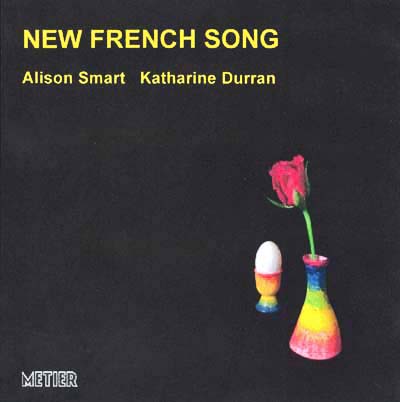
New French Song Twenty new settings of French words by
British composers |
|
Click here for : divine
art webpage
|
Review of the CD :From MusicWeb InternationalAny release
that broadens the range of art song before the public immediately
arouses my interest. The idea of getting twenty British composers to
set French texts might initially raise fears about the love-hate
relationship that supposedly exists between the two nations. Nothing
could be further from the truth, and this disc is much the stronger
for it. The listening
experience is interesting too; indeed one could think of this as the
musical equivalent of twenty miniature images displayed in a row. With
each track you’re moved along the line to something new. Each is by
its very nature a concentrated experience as there’s no growing
accustomed to a continuity of style or technique. What is each
composer’s sensitivity and approach to text like and which takes
primacy in performance, text or music? Then there’s
the texts ... and the range of poets covered. Here in this case are
some of the true greats. In one case there’s the opportunity to
compare two settings of the same text. The excellent
booklet includes full texts with translations accompanied by composer
and poet mini profiles. We are told how the project was borne out of
the experience of these artists performing Poulenc and Fauré in 1999.
Whilst only a couple of the works presented here have anything
approaching the subtlety of response that those great Frenchmen
exhibit in their chansons, they nonetheless offer adventure and
amusement that is amply rewarding. Indeed it is often the more
off-beat texts that have the staying power: Beckett, Crane and Satie -
who else could make a list of white foods bring a smile to your face? There is a
tendency here to explore vocal extremes, be it in terms of range
(Redgate) or intensity of attack (Gorb). However, this is balanced by
the inner calm and reflectiveness that others achieve. Tarik
O’Regan’s Mallarmé setting hasn’t failed yet to draw me in and
make me stop everything to listen, so too McGuire and Jackson. Others
instil different reactions. Harrison appears extract-like. Redgate
takes the song to the point of vocal abstraction. Bingham has a slight
indifference to the text perhaps. Then there are the gentle nods from
one composer to another artist: Jackson to Debussy and LeFanu to
Whistler. Listening to
the whole disc at one sitting might be a touch wearing, and quickly I
adopted the pattern of listening to smaller groups. As with most
intricately created miniatures inevitably there were facets that
revealed themselves only on repeated visits. Gradually preferred
individual songs and groups emerged. Groups of poets, groups of tempi
– alike and contrasting – allowed for the creation of
mini-recitals drawn from the overall pool. For example, I found the
following particularly effective: the contrast between Todd and Cowie
or the suitably questioning Roe against Skempton’s lilting rhythms
and natural linguistic feeling. Whilst Alison
Smart is set a tall order by the composers, to my ears she makes a
strong case for these songs. Perhaps here and there one regrets that a
feel for the inner music of the French language is sacrificed a little
so that a vocal high wire act can be pulled off. But then that maybe
shows a composer’s lack of innate linguistic affinity too. Katharine
Durran offers solid support throughout, her instrument being recorded
closely, but allowing for a nice atmosphere to develop around it –
though it too can be insistent when required by the likes of Bingham
or Fitkin. Artistically
enterprising and uncompromising, with excellent production values too,
this Metier release is well worth exploring.
Evan Dickerson |
|
How often do you get twenty British premières in one concert in
one evening? Probably very rarely, if ever. Congratulations then to
soprano Alison Smart and
pianist Katharine
Durran for devising such a fascinating programme under the title New
French Song. For their Purcell Room recital on 13 July they commissioned twenty
British composers to set music to any French literature of their
choice from the past 200 years. The selected texts covered a wide
range of writers from the Romantics and Symbolists right through to
the post-Modern era; one of the composers, Edward McGuire, chose to
set his own text to music. The result was a medley of songs on the
subjects of life, death, memory, youth, the Tour de France and even a
rather bizarre dinner menu! What was very interesting about this concert was each composer's
personal response to the imagery and language within their chosen text
and whether they chose to pay homage to the French harmonic language
and textures of the past or to go a different route. Gabriel Jackson's
setting of A la Mémoire de Claude Debussy by Jean Cocteau was
the most overt in its reference to Debussy's piano music and harmonic
language of once-forbidden parallel fourths and fifths. Edward Cowie
nodded towards Debussy and Messaien in his use of birdsong, while
Tarik O'Regan and John Casken were particularly interesting in their
impressionistic textures and colouring. Otherwise these song-settings
were disparate in their huge variety of compositional ideas and
methods The most powerful song of the evening was Adam Gorb's setting of
Charles Baudelaire’s La Cloche Fêlée; this terrifyingly
intense, chilling poem was musically portrayed by the particularly
effective writing in the piano, employing opposite extremes of pitch
and with bass tones stopped inside the instrument by the pianist to
conjure up the death rattle of the bells. Alison Smart was in full control
of her voice throughout the recital, pitching the frequently
challenging vocal lines with ease. Though hers is not a huge voice and
her diction was occasionally under-projected, she elicited a really
impressive range of colours and contours, comfortably handling the
stylistic changes between songs. She was, without doubt, helped by
having a true painter as her partner at the keyboard. With a
remarkable sensitivity and wide palette of colours, Katharine
Durran’s playing was a musical lesson in Art history. Let’s hope
that this duo persuades other performers to jump on the bandwagon and
further explore what our composers today have to offer. Magnus Carey Musical Opinion September/October 2004
|
|
|
Click here for : divine
art webpage
|
Review
of the Première : New French Song
|
|
Click for : divine
art webpage Back to Index of poets and composers
|
BBC
Singer ALISON SMART specialises |